Wednesday, May 7, 2014

11. Commerce. 4th and 5th of March of 2014

4th and 5th of March of 2014

We have done at the fourteenth and fifteenth days:

Commerce:

At the fourteenth and fifteenth days, the teacher has told us about the commerce in the Americas. 

After the colonization of Americas, the products from America was gone by Europeans to Europe, for instance: silver, gold, and cocoa,tomatoes, potatoes and more. And some products brought by the Europeans, like sugar or coffea planted in America was brought by Europeans to Europe again.


The evolution of the colonial commerce, it could be different, because it had  three forms, the first one was local or regional. After the conquest were different form to trade, but the indigenous market continued, and others with Europeans’ products, and appeared another one, the mixed trade sites.

Colonial market
The second one was, the commerce of the intramerica, was intramonopoly, and there was direct link with Europe. This is the intermediary trade, between the regional or local commerce and the intercontinental commerce.

The third one was, the Intercontinental, that’s one is the best known, is the trade from America to Europe and Europe to America. It is known more than others because we have a lot of documentation available, and we have these information by the lots of documents done when the sailors left Seville to go to America.

The Castile/Spain:
 The colonization and the conquest of America belonged to the Castilian Crown, only Castilians could be go to America.  The last one the colonial unbalance and the Spanish Empire had a monopoly, in the house of the Crown. At 1503 started the American colonies trade monopoly, with the single port system, in Seville, by Casa de Contratacion.

 Why Seville elected?  
At 1520 the first attempt to put multiport system was done, and until the 17th century, because Seville was in a strategic site of the Peninsule and it had a good exit to the Atlantic Ocean., and of course it was protected by Guadalquivir river.
Seville at XVIIth century

At 1561-1562. The routes of Flotas y Galeones: “Flits and Galleons” started. The Galleons were  the flit who had gone to Peru with Cartagena de Indias to Portobelo and to Panama and last one Peru’s Viceroyalty and the Flota to New Spain with Veracruz to the Viceroyalty of New Spain.
The return, of course, was an only one flit, the mixed flit by the Flota and Galeones. And at 1582 it was fixed the law and put another one, called Ordenanzas de Flotas y Galeones.
Flits of Spain

At 17th century, that system, will be on crisis. To controlled that, it was used the military control to protect and to control the flit, and the other one was the change of the  canlendar.

At 18th century that system will be desmantelated , but by a process, the first step was since 1717 until 1739, the second step was since 1739 until 1754 and the third one was since 1754 until 1776.


10. The Church in the colonies. 27th of February of 2014

27th of February of 2014

We have done at the thirteenth day

The Church in the colonies:

At the thirtheenth day the teacher has told us about the power of the church in the colonies, and what kind of things it did on the Colonies.

At the 16th and 18th centuries, the church had a lot of power in the colonies, and we can see a very big collaboration, with Kings and Church, and there were juridical relationship between church and state. From the beginning there was The Royal Patronato of the Indies, and the Colonial people belonged to Catholic church of Rome. 
In the Bourbon era the defense of Regalism become more important.

The patronato was an agreement between, the church and the civil powers, about the control of the church(as local space). Agreement between the Crown of Castille(owner of the sovereignty rights on America, and the Holy See, in order to regulate their relationships.

To do that the Crown and the Holy church did some legal text, which permited to control those churchmen and the parishioners.
There are the main texts:


-Pope Alexander’s bulls, 1493
-Bull of donation of tithes (hamarrena), 1501

-Bull of Universal Patronato, 1508

In all of these bulls, there were the juridical foundations of the DONATION. And there were others, for instance, obligations(foundation and provision), and Rights (presentation for ecclesiastical positions).

The rights of Patronato were granted by the Pope, through the following four bulls to the king of Castille:
1.      Inter caetera(Alexander VI) 1493
1.      The Crown accepts the exclusive obligation of supportin the efforts to evangelize the Indians.
2.      In order to Christianize the Indians, it is necessary to send missionaries. Sr the Crown has both:
The right to select the missionaries to be sent.
Th obligation to support financially their transport and maintenance in America.

II: Eximiae Devotionis Sinceritas(Alexander VI) 1501.
III. Universalis Ecclesiae refiminis(Julius II) 1508.
IV. Expone Nobis: Omnimoda(Adrian VI) 1522. The Kings of Castile are granted the right to elect the missionaries to be sent  to America(from the list  presented by the authorities of the religious orders). The Crown(through the Council of the Indies) will determine the NUMBER and the actual DESIGNATION of the candidates.

Limits of Patronato What cannot the Crown do?
-To give any rule on doctrine and dogma.
-To act against the immunity and particular jurisdiction of the clergy and the Church.
And what can do?
-To develop a system for controlling the activities of the churchmen elected by the aforementioned system of “presentation”.
-An overall control of all the ecclesiastical institutions dioceses, parishes, hospitals temples in general anything related to the Church.

-The control of all the economic income of the Church, and specially the correct application of the Royalo Two Ninths of the tithes.

The weak limits of the control:
-“Pase region”
-No nuncios in America
-Visits “ad Liminia”
-No to Propaganda Fide
-Strich control of the council of the American bishops and archbishops.
Evolution of Patronato:
-Patronato as such: 1492.1574
-The vicarship of the indies: 1574-1749
-Bourbon regalism: 1749-1821
After the independence the new sates will claim their right for a “national patronato”.

-Missions or the border 17th century, on the British colonies:
They were done in the border of the indies, and in the border or empires. But we can say, that not in the all part of the colonies the missions were the same, because in the different colonies the religion was different.


P.D: I do not understand very good this topic, so I do not know if it will not be fine.


9. British colonies society organization. 26th of Februray of 2014

26th of February of 2014

We have done at the twelfth day

British colonies society organization:

At the twelfth day the teacher has told us about the society and organization of the British colonies in the Early Modern Age, since XVIth century until the Independence of the colonies.

At 16th century, North America’s British colonization start in Roanoke in 1586-91 by Walter Raleigh  worked to English crown and he was the lover of Elisabeth the 1st, was the first man who taken the tobacco and carried to England. 

At 17th century, the really colonization started, the English crown try to perform an organization and began the King James’ grants, and English people want lands from south barrel and the north barrel. To do that, at 1606 in England was created companies, but those companies had to recognize the king’s power in those lands. London’s company and Plymouth Company were the companies who must have done the colonization.
One year after that, at 1607 the London company did the first British colony created in the North, the city of Jamestown, but in 1624 disappear The London company.

The Plymouth company also finish by 1635 because is disappear. The Plymouth Company did Plymouth city at 1629 and the land was called Massachusetts.

And in 1629 the Massachusetts Bay Company did colonization with people who want to go to colony and left their real land.

When this form of colonization finished, the crown instead of gave grants to companies, gave grants to companies and privet people, but if they demonstrated they had money and sources to do that. And it base in, to take a portion and prolonged this portion to the end of the land. And the land what doesn’t belong to anyone this land belong to kings( Common Law).

 From the 30ties to the middle of the century, the North part of the colonies belong to Penn, and there were called Pennsylvania, for example.
In the South it was done by a different form, because they belonged to Crown and mantend  those colonies, and they were named, Caroline and Georgia.

-Forms of colonization:

The first step was since 1632 until 1640. They went to North part of Colonies and they called it New England. They were 20.000 people more or less and they were Middle/Low class people, mainly farmers but not only.

The second step was since 1642 until 1660. They went to South part of Colonies called Virginia, and they were about 40.000 people, who were  big landowners, middle class Indentured.

The third step was since 1700 but thery weren't English people. In 1750 a quarter of the total population in the colonies has no English ethnic origin. For example the Huguenot from Bayonne. The irish-scottish people, and Amish( From Germany).

All of the colonies were separated by Mason-Dixon line, to divide Pennsylvania, Maryland, Virginia and Delaware.


 The British empire in North America.


8. The juridical situation of the American territory historiographical debate. 20th and 25th of February of 2014

20th and 25th of February of 2014

We have done at the tenth and eleventh days:

The juridical situation of the American territory historiographical debate:

At the tenth and eleventh days, the teacher has told us about the juridical situation of the American territory in Spanish colonies and British colonies.

Spanish case:

In the Spanish case, the zone under the control of Spain in Americas, was called Kingdom of Inides.
The kingdom of Indies is an other organization of the Castilian Crown and, like the Elisabeth the Catholic said in 1503, the inhabitants of the Indies were subject. And the new conquested lands in America were assimilated by the Castilian Crown and they put cabildos on the cities, more or less the same organization of Castille. 
Those aspects for instance appear Ricardo Levene’s Las Indias no eran colonias.

But those lands really were colonies so they had political and economical dependence, and America and Castille weren't in the same position. Because in Castille the lenguage was Spanish and in America was criollism

-First attempts to organize(1492-1535/43)

In the first 8 years the conquest became kingdoms, more or less in Antilles
When the Spanish people took territories in Terra Firme, so in the continent, the land that was took became a land belonged to governor until the died, and when the governor died the land returned to Spanish crown.
The land belonged to governor were “governaciones” but when the conquest of Aztecs and Incas empires done, this form of govern became impossible to do. So start other form to govern like

Were three forms of institution, in the first step, on the top was central institution, in the second step was regional institution and at the end was local administration

-Central instituions:

Govern of the trade from America to Europe, appear one institution:  Casa de la Contratación ( House of Contracting(1503), that corpus control, until 1718 was the only port that had permission to trade with America.

Consejo de Indias- Council of the Indies(1524). The council hadn’t birth because it appeard step by step from the Council of Castille. It decided and controlled civil and ecclesiastical topics in America. Everything coming from America was doing by that Council.

-Regional institutions:

Governaciones: This is the first one, and it created colonies, and "capitulaciones", it had competences on govern, it has an equal institution called Camptaincies. During the colonial age they were the basic and of the administrative system of the Colonial Spanish America.

Audiencias: They were High Courts or Tribunals but nothing to govern. This was a system to avoid the abuses of one person governing bodies, but the Crown put in Audiencias, a governor president.They had : competences in Justice and governmentm, and they were formated by : oidores(judges), president(not judge), prosecutor, protector of the Indians.

Viceroyalties: They were the most important regional institution, and they were two until the Borbon dinasty arrived to Spain. The first one was New Spain viceroyalty, borned in 1535 and the second one  was Peru viceroyalty borned in 1543. 
The first one was a consequence of the failure of the two previously attempted system of government: the term of governor Hernan Cortes and the term of first: Foverning audiencia of Mexico.
The second one was, in order to assure the implementation of the “New laws” one of whose aims was to erase forever the institution of “encomienda”(Peru’s Civil Wars).


                                                    Viceroyalties since XVIth century until XVIIIth century

When the Borbons arrived to Spain  Appear two more  viceroyalties: Nueva Granada and La Plata.
                                                  
                                                            Viceroyalties since XVIIIth century

But  wasn’t uniform and hierarchical, because was the vertical accumulation of power, and the asymmetrical power and competences of institutions. And to avoid all the step, all of step belonged to one person.
And the other problem was the situation.
When the Borbon’s arrived to the Crown  put intendencias. So were: Governaciones-Intendencias-Audiencias. In the borders put capitancies and commandancies.

Conclusions: “ Lack of planification.” There was not a single, simple structure: but an accumulation of laws. Balance between unipersonal and collective institutions of government. 

British case:

In this case the organization was that:
-In the first step: Crown
-In the second one: Governation
-In the third one: Assambly, to organizate the land.

7. Slavery and the business of this. 18th and 19th of February of 2014

18th and 19th of Ferbruary of 2014

We have done at eighth and nineth days:

Slavery and the business of this:

At the eight and nineth days, the teacher has told us about the slavery and about the business of this topic.

The slavery was invented at 16th century, but before that the slavery exist in the Roman Empire, and in the Middle Age, and we can say that the muslims took slaves from Middle Africa to Mediterranean sea's ports but when the Ottomans took Constantinople and closed the routes of trade, the Europeans started to find another routes to took slaves in Africa, and since the Europeans found America put a triangular commerce web on Atlantic Ocean.

Triangular commerce:
-Europe to: America,products from Europe and African slaves
                  Africa,products from Europe
-Africa to:  America, products from Africa and slaves
                 
-America to:  Europe, poducts from America


                                                                Triangular commerce

The organization of the trade was difficult, and we can say that was participation of the crowns called "Asiento", at it was trade bringing from Africa to America fixed slavery people. We know that in a Brithis America's colonies the taxation was most huge than other crowns and countries.

The calculating of the trade was called Pieza de Indias, and one pieza of indias was a young male person, called bozal, they were 15-30 years old. The Young female was 0'75 of pieza and if they were chil, they were called child bozal and they were 0,5 of pieza.

-Capturing Slaves in Africa:
In the ports of the coast of Afica the Europeans put settlements to trade with African Kingdoms or countries, but the Europeans didn't hunter slaves, because in the christianity, it isn't acceptable done that, only when the excuse is cannibalism.

-The Travel to America:
The travel wasn't good, because the sailors put the slaves on the ship so that the space was maximized. But the travel was two month and a half. And while the travel, could be spend riots and uprising, and the health of the slaves wasn't very good. At XVIth century the 40% of the slaves died befroe arriving to America, at 17th was the 20%, at 18th was 10% but at the end of the 18th century and the 19th century more than 10% slaves died.
And the sailors not to pay more than they put on the contrats, put more slaves than they signed.

-From where, to where...
All of the slaves were from Afican Coast and most of them went to Brazil, Spanish Empire and British Empire
And then they were put on plantations of sugar, tobaco, cocoa and cottom.

Tuesday, May 6, 2014

6. The evolution of population.The immigration of Europeans. Figures,control, legislation. 11th,12th and 13th of February of 2014

11th,12th and 13th of February

We have done at the sixth and seventh day:

The evolution of population.The immigration of Europeans. Figures,control, legislation:

At the sixth and seventh day, the teacher has told us about the evolution of the population in America, whit the immigration of Europeans and what control and legislation used for it. At the first day we read textes about the topic of the dissapearing of the indigenous people, and we must have to take some factors to explain this topic.

The evolution of indigenous population:
At the end we showed our explanation about this topic and the factor that appeared were those: 
Direct Killings, overworking, famine, disruptor of societies and indigenous collapse.

But are differents examples about this topic, because of the different owner of those lands; it wasn't the same the North indigenous people condition or The south indigenous people. The indegenous or indian people, is the people who weren't white but the at the moment, the legal form is the people who had 100% blood of Indians.

In the Spanish Empire the indigenous people in the first part of the colononization dissapeard, for instance in Hispaniola or Cuba island, in the second part of the colonization the big amount of the indigenous died in bad conditions, for example working in the mines, and in the third part of the colonization, the Spanish empire's king and governors declared ilegal the slavery of the indigenous, so indigenous people get into the Spanish empire's society. Nowadays we can say that more or less, all of people were living in South America was half-blood(mestizo), a mixed of white and indigenous people.


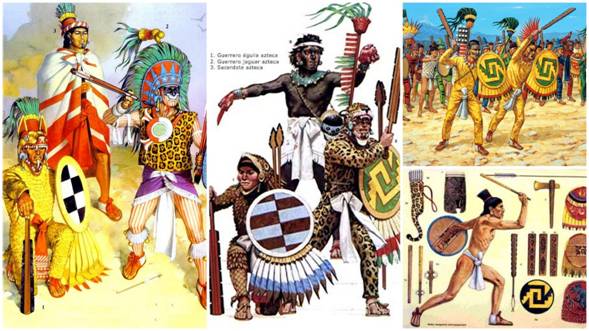
    Aztecs, Mayas and Incas


But in the other hand, in the British Colonies the people from those colonies, didn't accep the indigenous because their religion, above all the puritans.


Iroquois ligue

The immigration of Europeans.Figures,control and legislation:
Since 1600 about 74 milion people migrated from than birthplace to other kingdom, state or land.
In the case of Europeans, the agest of big migrations started whith the conquest of America. In the Early Modern Age, the European migratory process, the two meanings of "colonization" appear together. Are three models but two main model, the first one Iberian model: Castille+Portugal, the second one English/British model and the last one the less important French model.

-Castile/Spain Model:

In the colonial age, we don't know about  the how many people went to America, because there are some difficulties to know that, and this is not a very clear concept, and they are different methods to computing those amount of people, and we have only the lists of travellers, because is the only legal emigration. 
But  in the other hand the ilegal emigration exist so it become the knowledge imposible. 
To add to it, we can say that in America appeared two kind of Spanish people, the European Spanish people and the Spanish people who born in America, called "criollos"

The Spanish people were from Castilian Crown and Navarre until 18th century when the Catalunian people went to America.
But the Crown put a difficulties to travel to America, and to travelling the people had to be catholic and subject of Castille, and the people more or less prefered go to Aztec's and Inca's empires, where there were the stronger colonies.
-Immigration to the British colonies, the English model:
This immigration started since 17th century until the Independence of the U.S.A. But the organization was different in this case. First of all because the colonization was done by the people not by the Crown, and the colonization of the East coast of the Norther America is different. For example  the Puritans went to Massachussets by the Mayflower ship. Quackers went to Rhode Island and some part of Delaware, Catholics went to Maryland and so one...
After was another people who appeared.At the end of 17th century, English was 1/4 milion, 100.000 from Germany and another from France, Netherlands and Sweden.
    British colonies in North America
  -The colonies of France:
French people, put colonies from Acadia in the Norh east coast of North America, following the St Lawrence river to the Great Lakes and then following Mississipi river to New Orleans. Those lands called, the north New France and the south Louisiana. And in the Caribean sea France put some colonies in some little islands and in the west coast of Hispaniola island, nowadays Haiti.

Those colonies were connected by some settlements around the rivers, and they were put by French people and some soldiers but not more than 100. 
In 1654 they were around 300 people, but in 1666 they were 3215 people and six years after, they were 7000 inhabitants. 
In 1773 the total population was about between 65000 and 70.000 people but, at that moment, the North Part of the French colonies belonged to British Empire and Louisiana to Spain.

            Nouvelle France and Louisiana, French colonies


Sunday, May 4, 2014

5. The Conquest of the Americas (1492-.....) 4th and 5th of Ferbruary of 2014

4th and 5th of February:

We have done for the forth and day:
The conquest of the Americas(1492-.....)

At the forth and the fifht day the teacher said us, when we speak about the conquest of America, we can take into account two concepts: Conquest and Colonization.

-Conquest: means invide the land becoming yours using force, or, The subjugation and assumption of control of a place using violence.
-Colonization: Establish political control on the indigenous people of an area. This is word using in 18th century.

The conquest of America was done from 15th century to 19.century, but the most important periods were 16th and 17th centuries. The first one was the period of Iberian conquest and colonization, only by Portuguese people and Castilian people. The second onde was the period of the rest of countries. At the first period, the richest part of Americas become Spanish.

16th century: Castille and Portugal cases

-Case of Castille:
The first conquest was Hispaniola and at hte end of the century Castille finished its conquest.

                                                                 A map of Precolombial period Latinoamerica, 
                                                                       North America a and South America.

1.The first period is the Colonish period. It is based on a conquest of islands and put some settlements or ports to comerce with "Canton(China)" but it wasn't true, because they comerced with Americas' civlizations.
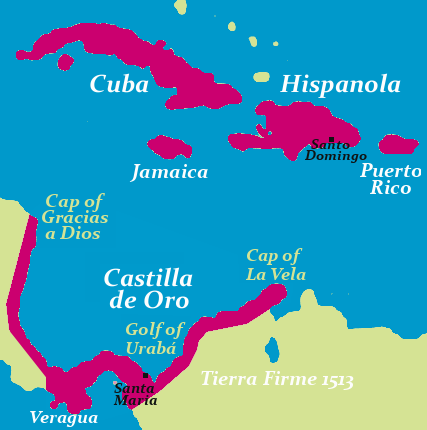
File:Indias 1513.PNG
                                                                  Islands and Mainland in the Ocean Sea at 1513
2. From 1510 to 1520 was the sencond period, It was based the route to "China" and the spanish people took gold or another metal to Spain and to do that the Spanish people make relations whit Aztecs and Mayas.
3. From 1521 to 1550 is done the conquest of the Great Empires, the first one was Aztec Empire by Cortés and the second one was Inca Empire by Pizarro. At that moment the Spanish people thought that over Mexica's land was the 7 cities of Cibola and over the Inca's was El Dorado.
4. At 1580 Phillippe the second decided, not to move more. And at 18th century the spanish wasn't move more.

-Case of Portugal:
1Portuguese people from 1500 to 1502 put some ports called "feitorias" usually at the ends of rivers to trade with indiguenous people. And to do that they needed some people and becasuse of that, they couldn't do that, they began conquest Brasil with capitanies since 1532. And we casn say that the conques wasn't done by the state, but the King gave to some people privileges.
2. The second step was the create political state.

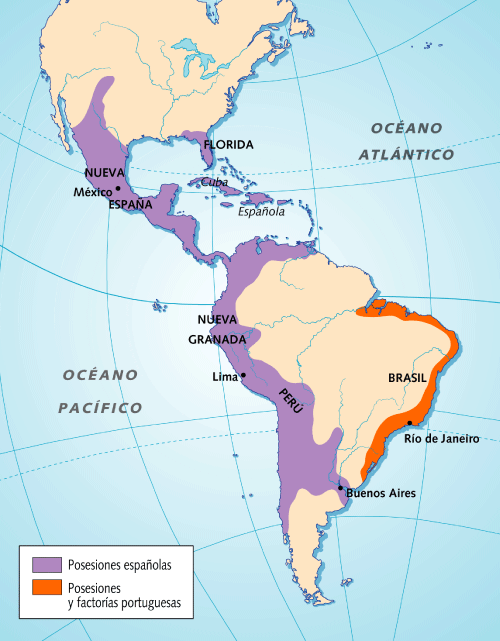
                         Castilian and Portuguese colonies and "feitorias" in Americas at the finish of XVIth century 

17th century: France, England, Netherlands, Sweden and Denmark cases.

-France:
The first settlements were put in Newfoundland and Nowadays Canada's east coast. At 1524 was done by Cartier the first expedition to Americas, and they were called by Cartier New France. From 1530 to 1540 the french people put settlements in the coast of Saint Laurent River, for instance: Quebec and Montreal foundated by Ascona and Ochelaga(Basque people). Those colonies made commerce with the indigenous people trading fish and other thigs.
From 1603 to 1632 Samuel de Champlain founded some cities and Quebec, Acadia and Louisiana passed to French Crown. From Quebec to New Orleans, at that moment Nouvelle Orleans, French people put a route doing some Settlements. And in another part of Americas, in Caribean sea, France took from Spanish Crown some islands but in the little Antilles.

-England:
The first settlement was put in nowadays Virginia, at 1607 and it called Jamestown. Since that moment to 18th century English people did some colonies in Hudson Bay Territorie, Caribean Sea's small islands to trade with the British Empire and to pirating, stolen silver,gold and another thigs to Spanish.

Norther America. In the map we can see, English colonies, French Colonies, Spanish Colonies and Russian Colonies.


-Netherlands:

The first colony from this country was Niew Amsterdam and in the Caribean Sea took some islands from Spanish Empire from 1625 to 1664.


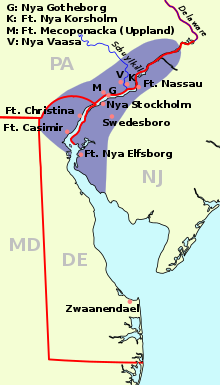
-Sweden: they put some settlements on the Hudson River.

Sweden colony
-Denmark: They took Greenland, and in the Caribean Sea some islands for instance: St Thomas and St Croix.

The collision of countries:

In Americas the countries from Europe against between them to took the biggest part of land.
-Russian people conques Siberia and Alaska and the last one was buyed by U.S.A in 1860
-1763, after the Franco Indian war, the Frech people lost their colonies in Americas by the English people, and the rest part of their colonies were given to Spain. And for example the Acadian people went to Louisiana, which belonged to Spain at that moment and become cajun people.
-1780 It was done the treaty of limits and the expansion of Brazil

The end of the conques of Americas:
-After the independence of U.S.A, the American people conquested the land from Mississipi river to California, and the Argentinian people conquested Patagonia, called The conquest of the Desert, and from 1861 to 1883 was the war on Arauca. And Brazil from 1880 to 1960 has done the occupation of the Amazonia.